Microsoft Dynamics 365 Business Central
One cloud ERP for finance, inventory, sales, purchasing and warehousing, built for small and midsize companies and connected to Microsoft 365.
See Business Central in three minutes
Microsoft’s official overview of Business Central: how finance, sales, inventory and operations come together in one system.
- Connected finance, sales and operations
- Built-in Microsoft 365 and Copilot features
- Runs in the cloud, accessible anywhere
One system for the whole business
Financial management
General ledger, payables, receivables, bank reconciliation, dimensions and financial reporting.
Inventory management
Items, variants, locations, costing methods, reorder points and planning suggestions.
Sales
Quotes, orders, invoicing, pricing, discounts, credit limits and customer management.
Purchasing
Purchase orders, vendor management, receiving, approvals and drop shipments.
Warehouse operations
Receipts, put-away, picking, shipping, bins and inventory movements.
Manufacturing (Premium)
Bills of materials, routings, production orders and capacity planning.
Reporting & analytics
Role-based home pages, Excel analysis and Power BI on live data.
Integrations
A Shopify connector, Microsoft 365 and Dataverse links, and open APIs.
Extensions
Apps from Microsoft AppSource and custom AL extensions for specific needs.
Is Business Central enough for your operations?
For most small and midsize distributors it is. For very high-volume or complex warehousing, an extension or Dynamics 365 Supply Chain Management may be a better fit. Because we've worked hands-on with both, we can give you a straight answer.
Business Central
Standard inventory and warehouse processes: receiving, put-away, picking, shipping and bin-level stock for small and midsize operations.
Business Central plus a warehouse extension
Barcode scanning, handheld devices or more advanced picking, added through a specialist app from Microsoft AppSource.
Dynamics 365 Supply Chain Management
High-volume or multi-site warehousing, advanced wave picking, transportation management and complex supply chains.
Signs you've outgrown entry-level accounting
- Inventory lives in spreadsheets. Stock counts and costs are tracked outside your accounting system.
- Several companies or locations. Consolidation and inter-company work take days.
- Reporting is manual. Month-end means exporting and rebuilding reports in Excel.
- Too many disconnected tools. Orders, stock and accounting are reconciled by hand.
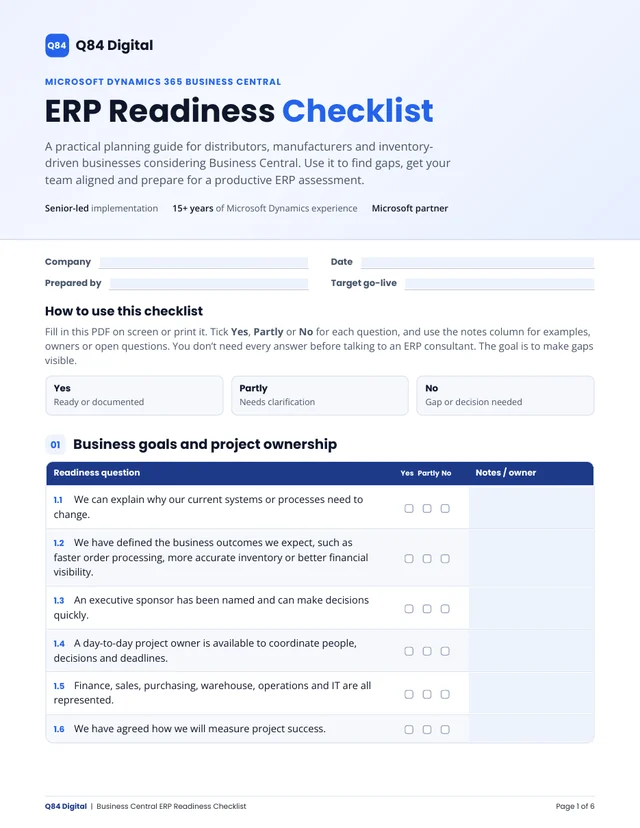
Check your readiness before you choose
Our free ERP Readiness Checklist covers 52 questions across 9 areas, from inventory and warehouse to data and budget. Fill it in with your team, then bring it to your assessment.
Fillable PDF, 6 pages. No email required.
See whether Business Central fits
Tell us how your business runs today. We’ll tell you honestly whether Business Central is the right choice.